
The NFT market has not disappeared. It just looks very different from the market people were talking about four or five years ago.
Profile pictures are still trading. Bored Apes still have buyers. Doodles remain active. Donald Trump’s digital trading cards continue moving between wallets. What has changed is the mood around them.
Collectors are less impressed by a famous name, a busy Discord server or a vague promise involving the metaverse. Prices have fallen too far, and too many projects have faded away, for that old sales pitch to work as easily as it once did.
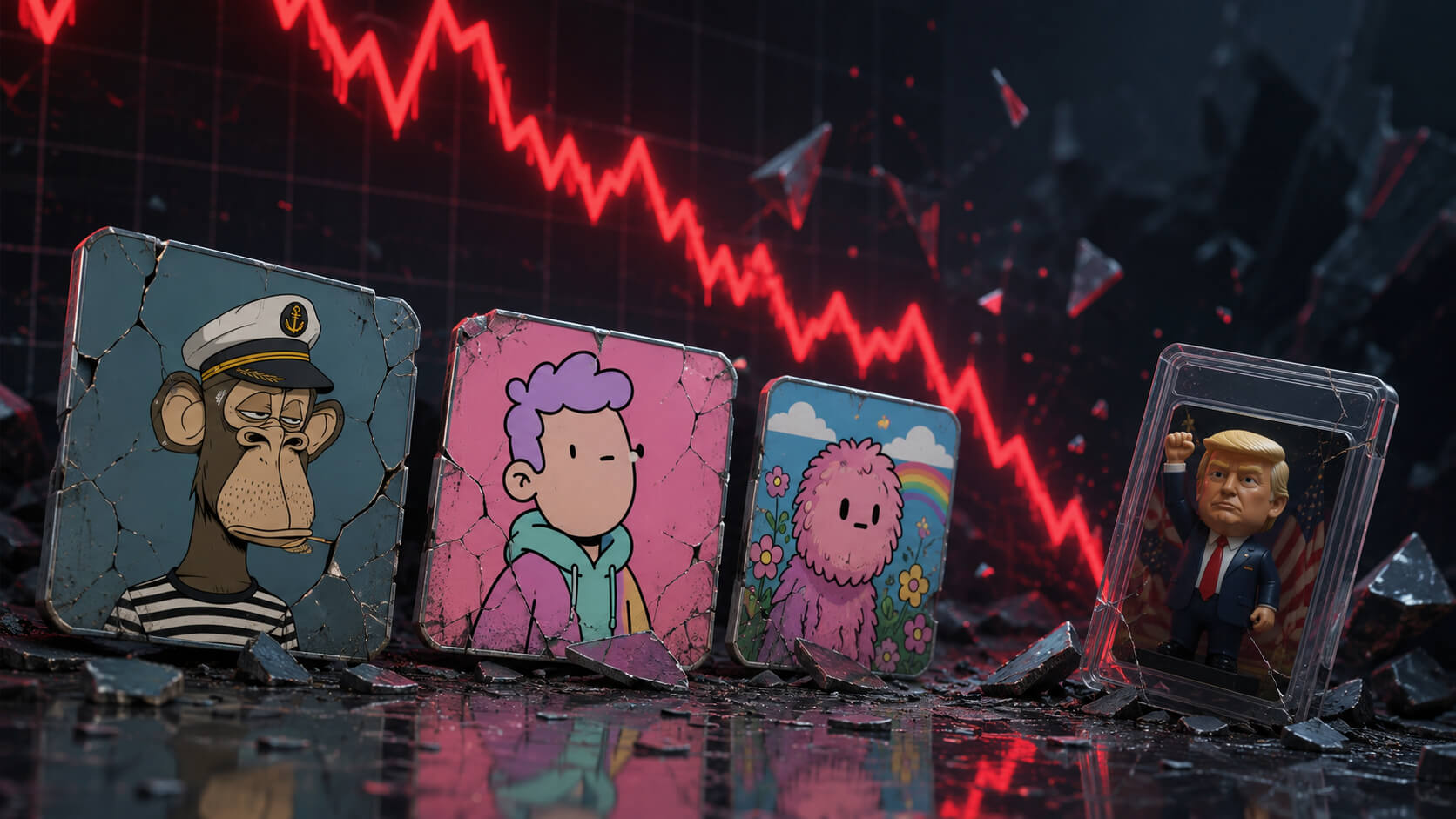
The latest NFT price collapse is forcing the industry to confront a simple question: what exactly does a digital collectible offer after the hype is gone?
The NFT Price Collapse Has Changed the Conversation
During the NFT boom, almost every project seemed to be selling the same dream. Buy early, join the community and wait for the collection to become the next CryptoPunks or Bored Ape Yacht Club.
That formula produced huge sales and even bigger expectations. It also attracted speculators who were not particularly interested in digital art, online identity or long-term membership benefits. Many were buying because they expected somebody else to pay more later.
That cycle eventually broke.
TradingKey described the 2026 market as a corrective phase in which the wider value of NFTs had fallen sharply from earlier peaks. The report argued that the decline was clearing away part of the speculative excess and pushing projects toward more practical ownership models.
Calling the drop a healthy correction may sound generous to anyone who bought near the top. Some collections lost most of their previous value. Others effectively became impossible to sell.
Still, the crash has made one thing clearer. A collection now needs more than attractive artwork and an ambitious roadmap.
Bored Ape Yacht Club Is Still Standing, but the Numbers Look Different
Bored Ape Yacht Club remains one of the most recognizable names in the NFT sector. It is also a useful example of how much the market has changed.
At the height of the boom, Bored Apes became online status symbols. Celebrities bought them. Brands referenced them. Holders displayed the artwork as social media profile pictures and used membership in the community as a kind of digital identity.
The collection has not vanished, but its floor price sits far below the levels reached during its most speculative period. Current trackers place the Bored Ape floor at around 9 ETH, although prices vary between marketplaces and can change quickly.
Nine ETH is hardly worthless. It is just a long way from the six-figure dollar valuations once regularly attached to the collection.
Yuga Labs has spent years trying to turn Bored Ape Yacht Club into something broader than a set of cartoon profile pictures. Games, merchandise, intellectual property rights, events and the Otherside metaverse have all been part of that effort.
The market is now deciding whether those additions create lasting demand or simply make the original NFT experiment more complicated.
Doodles Is Trying to Become an Entertainment Brand
Doodles faces a similar problem, although its strategy has leaned heavily toward entertainment and consumer branding.
The colorful collection built a recognizable visual identity early. It later expanded into animation, music, live experiences, merchandise and partnerships, positioning the project as an entertainment property rather than a collection that lives entirely on a blockchain.
That pivot makes sense. A character brand can potentially reach people who have no interest in crypto wallets or NFT marketplaces.
Its original NFT collection, however, still trades in a much colder market. Recent data placed the Doodles floor at roughly 0.43 ETH, with relatively limited daily sales compared with the frenzy seen across major collections during the boom.
Doodles may eventually become a successful media brand. That does not automatically mean every original NFT will recover its former price.
The connection between a growing brand and the value of its digital collectibles is not always straightforward. Holders may receive access, rewards or status, but those benefits must be strong enough to create actual buying pressure.
A logo appearing on more products is not the same thing as a liquid market.
Trump NFTs Still Depend Heavily on Political Attention
Donald Trump’s digital trading cards sit in a slightly different corner of the NFT market.
Their value is tied not only to crypto sentiment but also to Trump’s public profile, political activity and the loyalty of his supporters. That can produce sudden bursts of trading whenever he makes headlines or announces a new crypto-related initiative.
The original Trump Digital Trading Cards collection contains 45,000 items. Recent market data showed a floor price of roughly 0.027 ETH, while daily activity remained relatively thin.
That does not mean the collection has no audience. It does mean buyers should separate political enthusiasm from market liquidity.
An NFT can have a well-known person attached to it and still be difficult to resell. Celebrity recognition creates attention. It does not guarantee a deep pool of buyers.
Trump’s collections also demonstrate how NFTs can function as fan merchandise rather than conventional investments. For some buyers, owning the card may be enough. For others, especially those expecting a price surge, the lack of consistent trading activity is harder to ignore.
NFT Coins and NFTs Are Not the Same Thing
Confusion between NFT collections and NFT-related cryptocurrencies continues to shape the market.
An NFT is a unique blockchain token connected to a particular item, image, membership credential or digital object. A utility token such as Decentraland’s MANA or The Sandbox’s SAND is fungible. One unit can generally be exchanged for another unit of the same token.
The distinction matters because their prices move for different reasons.
A Doodles NFT may gain or lose value based on rarity, collector demand, community interest and the benefits attached to that specific item. A related ecosystem token may respond to exchange listings, token supply, staking rewards, governance proposals or activity across the wider platform.
Buying an ecosystem token is not the same as buying an NFT from that ecosystem. The risks overlap, but they are not identical.
During the boom, that difference was often buried beneath marketing language. The weaker market has made it more difficult to ignore.
Solana Is Keeping Low-Cost NFT Trading Alive
Ethereum remains the home of many historically important collections, including Bored Ape Yacht Club, CryptoPunks and Doodles. Its transaction costs, however, have often made small NFT purchases awkward.
Solana has filled part of that gap.
Low transaction fees and faster settlement make the network more practical for gaming items, inexpensive collectibles and frequent trades. This does not protect Solana NFTs from falling prices, but it lowers the cost of participating.
That matters when the NFT itself may only be worth a few dollars.
Paying a large network fee to purchase an inexpensive collectible never made much sense outside the most speculative phase of the market. Solana offers a cleaner environment for projects that expect users to trade items regularly rather than hold a single expensive profile picture.
The result is a more active market at the lower end, although cheap transactions should not be confused with safe investments.
NFT Utility Is Becoming More Important Than the Artwork
Utility has become one of the industry’s favorite words. Sometimes it means something useful. Sometimes it is simply a replacement for the word “roadmap.”
Real utility could include event access, game functionality, licensing rights, memberships, loyalty rewards, physical products or verified ownership of another asset. Projects are also experimenting with NFTs as collateral, although lending against volatile digital collectibles carries obvious risks.
The shift is understandable. A profile picture has a hard time defending a high valuation when thousands of similar collections exist.
Projects now need to explain why ownership matters.
Even then, utility does not automatically create value. A membership is only valuable when people want access. A game item matters only when people play the game. Intellectual property rights mean little when nobody wants to build around the character.
The strongest NFT projects may be the ones that stop treating utility as an announcement and make it part of something people already use.
Security Problems Have Not Gone Away
Falling prices have not removed scams from the NFT market.
Fake collections, copied artwork, phishing links and fraudulent airdrops remain common. Well-known projects such as Doodles, Bored Ape Yacht Club and Trump Digital Trading Cards are especially attractive to impersonators because their names are familiar.
Collectors should verify the official smart contract before purchasing an NFT. Marketplace badges can help, but they should not replace checking the contract address through official project channels and blockchain explorers.
Wallet security matters just as much. Connecting a wallet to a malicious website can expose valuable assets even when the collector never shares a seed phrase directly.
The market may be quieter. The traps are still there.
NFTs Are Moving Beyond the Profile Picture Era
The term NFT itself has accumulated baggage.
For many people, it now brings back memories of overpriced cartoon images, celebrity promotions and projects that disappeared shortly after selling out. Companies experimenting with the same technology increasingly prefer phrases such as digital collectibles, tokenized assets or digital objects.
Changing the name will not erase the market’s history.
It may, however, show where the technology is heading. Blockchain-based ownership can be used for tickets, gaming assets, credentials, loyalty programs and authenticated digital media without making speculation the main selling point.
That version of the market is less exciting than a collection jumping 500% in a week. It is probably more sustainable.
The NFT Market Is Smaller, but It Is Not Finished
The NFT price collapse did not kill every major collection. It removed much of the easy money surrounding them.
Bored Apes continue to trade, though far below their peak valuations. Doodles is trying to prove that an NFT project can grow into a consumer entertainment brand. Trump’s digital trading cards still attract politically driven attention, but activity can be inconsistent.
None of these collections offers a guaranteed path back to its previous highs.
The next NFT cycle, should one arrive, may not look like 2021. Buyers are more skeptical. Liquidity is thinner. Projects are under pressure to deliver something beyond a picture and a promise.
That is uncomfortable for the industry.
It may also be exactly what the industry needed.
This article is for informational purposes only and does not constitute financial or investment advice.
Sources
- TradingKey – NFT Price Collapse 2026: NFT Donald Trump, PFP, Doodle and Bored Ape price analysis
- CoinGecko – Bored Ape Yacht Club NFT Floor Price: Bored Ape Yacht Club NFT floor price
- CoinMarketCap – Bored Ape Yacht Club NFT Market Data: Bored Ape Yacht Club NFT market data
- CoinMarketCap – Doodles NFT Market Data: Doodles NFT market data
- CoinGecko – Trump Digital Trading Cards Floor Price: Trump Digital Trading Cards floor price