
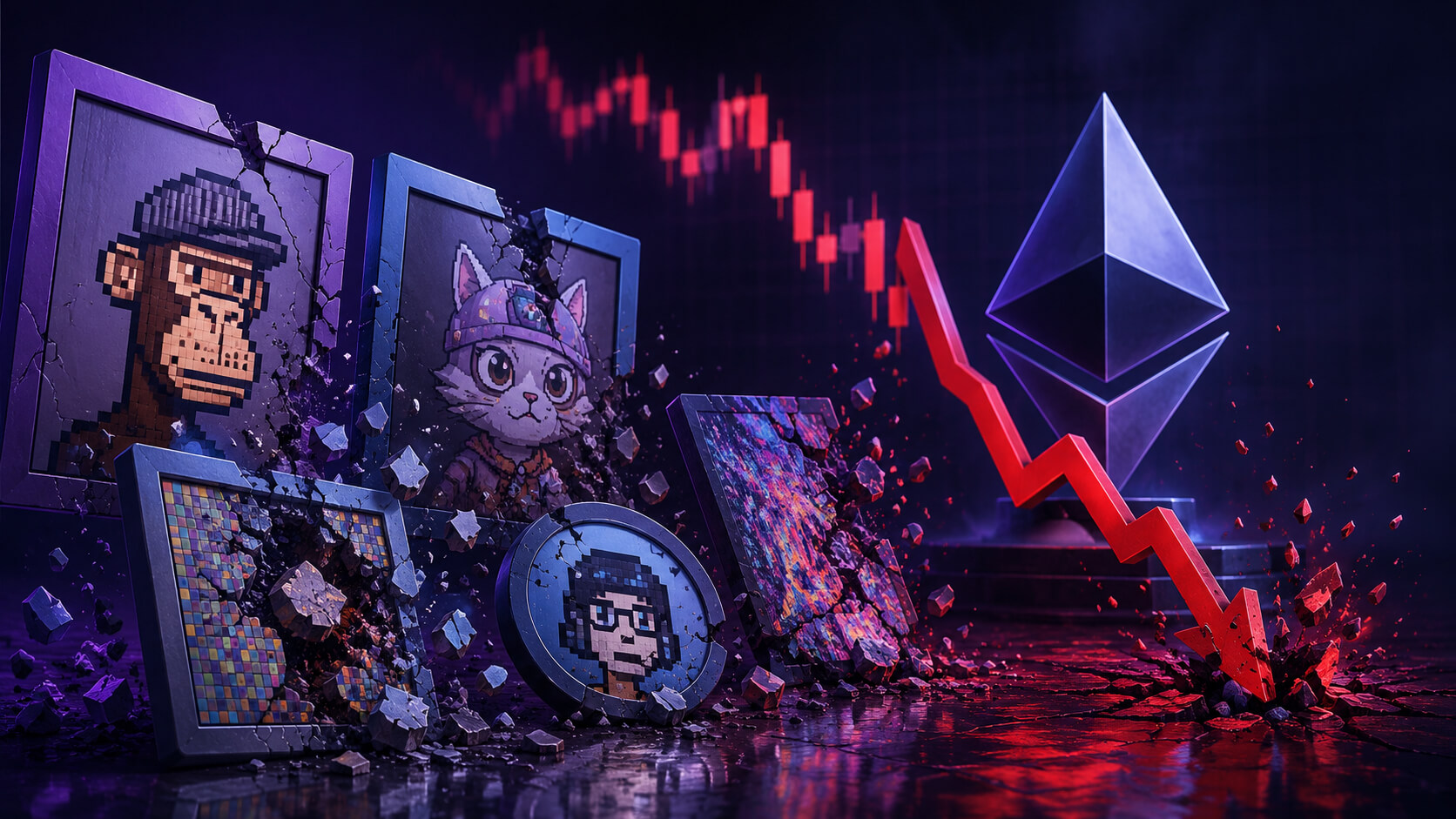
The NFT market’s latest recovery did not last very long.
After climbing alongside Ethereum, the total value of NFT collections dropped from roughly $9.3 billion to $8.1 billion in less than a week. That is a 12% decline, wiping more than $1.2 billion from the market as Ether pulled back from its recent rally.
It was a familiar kind of correction. Ethereum moved lower, NFT valuations followed, and even the collections usually described as “blue chip” were not protected from the sell-off.
NFT Market Loses $1.2 Billion After Brief Recovery
The NFT market had started to look livelier before the decline. Higher cryptocurrency prices were lifting collection floor prices, traders were returning to established projects, and the sector’s total valuation was moving upward again.
Then Ethereum lost momentum.
NFT market capitalization fell to $8.1 billion from $9.3 billion, according to NFT Price Floor data cited in reports from August 2025. Ether declined about 9% during the same period, sliding from around $4,700 to $4,259.
A billion-dollar decline sounds dramatic, though it needs some context. NFT market capitalization is largely based on collection floor prices multiplied by available supply. When the floor price of a major collection moves lower, hundreds of millions of dollars can disappear from the calculated market value without every holder actually selling.
Still, the fall was not just a spreadsheet adjustment. Trading activity also weakened across several leading collections.
CryptoPunks Remain on Top but Lose $300 Million
CryptoPunks kept its position as the largest NFT collection by market capitalization, but the collection took one of the biggest hits during the downturn.
Around $300 million was erased from its valuation, bringing the CryptoPunks market cap down to approximately $2.1 billion. Weekly sales volume also fell 34% to about $12.7 million, spread across only 51 transactions.
That low transaction count matters.
CryptoPunks are scarce, expensive and unevenly priced. A small number of sales can influence the floor, especially when buyers become cautious. There does not need to be a mass rush for the exit. A few lower-priced listings and weaker bidding can be enough to drag the collection’s broader valuation down.
CryptoPunks may still sit at the top of the NFT rankings, but the collection remains tied to the same market forces affecting everything else. Reputation helps. It does not remove volatility.
Bored Ape Yacht Club Suffers Another Sharp Decline
Bored Ape Yacht Club also lost ground as the NFT market cooled.
The collection’s market capitalization dropped nearly 20% to approximately $482.3 million. For a project that once became the public face of the NFT boom, falling below the half-billion-dollar level was another uncomfortable reminder of how much the market has changed.
Bored Apes still have name recognition. Yuga Labs continues building around its brands, and BAYC remains one of the first collections people mention when discussing high-value NFTs.
The price action is less forgiving.
Collectors are no longer placing the same premium on celebrity ownership, exclusive communities and ambitious metaverse plans. Those ideas have not completely disappeared, but buyers now appear more interested in what a project can deliver outside its original hype cycle.
Pudgy Penguins Overtake Bored Apes Despite Losing Value
Pudgy Penguins moved into second place among major NFT collections during the reshuffling, even though its own valuation fell by around $100 million.
That sounds contradictory, but rankings do not require a collection to rise. Sometimes the projects around it simply fall faster.
Pudgy Penguins has separated itself from many profile-picture collections by expanding into physical toys, retail distribution, licensing and entertainment. The project has spent years trying to turn its cartoon penguins into a consumer brand rather than relying entirely on NFT trading.
That strategy has not made the collection immune to an Ethereum downturn. It may, however, have helped Pudgy Penguins hold up better than some older rivals.
The collection’s move above Bored Ape Yacht Club was symbolic. BAYC represented the celebrity-driven NFT boom. Pudgy Penguins has leaned harder into products, recognizable characters and mainstream retail. The market appears to be giving that model more credit, even during a bad week.
Ethereum Still Controls the Mood of the NFT Market
The connection between Ethereum and NFT valuations remains difficult to ignore.
Most of the largest NFT collections were created on Ethereum, and their floor prices are commonly denominated in ETH. When Ether rises, the dollar value of those collections often increases automatically. More traders may also feel comfortable spending ETH when their crypto holdings are gaining value.
The same mechanism works in reverse.
A lower ETH price reduces dollar-denominated collection values before any change in the NFT’s underlying floor price is considered. Nervous traders may then lower listings or delay purchases, adding another layer of pressure.
This is why an NFT rally driven mainly by rising Ether prices can disappear quickly. The market may look stronger in dollar terms, but that does not always mean demand for the NFTs themselves has improved by the same amount.
Corporate NFT Purchases Offer a Different Signal
One unusual development came from BTCS Inc., which added three Pudgy Penguins NFTs to its corporate treasury.
The purchases were small compared with the company’s cryptocurrency holdings, but the decision attracted attention because publicly traded companies rarely treat profile-picture NFTs as treasury assets. CoinMarketCap described the move as another sign that some businesses are beginning to view established NFT collections as legitimate balance-sheet holdings.
Calling NFTs legitimate treasury assets may still be a stretch for many traditional investors. They are less liquid than major cryptocurrencies, valuations can change rapidly, and the buyer pool for expensive collectibles is fairly limited.
Even so, the purchase matters. It suggests that at least some companies are willing to look beyond Bitcoin and Ethereum when building a digital asset strategy.
Whether others follow is a different question.
NFT Blue Chips Are Not Acting Like Safe Assets
The phrase “blue-chip NFT” has always carried a little too much confidence.
In traditional markets, blue-chip assets are associated with established businesses, reliable earnings and deep liquidity. NFT collections do not operate that way. Their value can depend on cultural relevance, online attention, community participation, ownership benefits and the willingness of a relatively small group of collectors to keep bidding.
CryptoPunks, Bored Apes and Pudgy Penguins may be stronger brands than thousands of forgotten NFT projects. That does not make them stable.
The latest decline showed how quickly supposedly premium collections can lose hundreds of millions of dollars in calculated value when Ethereum changes direction.
The NFT Market Is Still Searching for Something Stronger Than Hype
The $1.2 billion decline did not kill the NFT market. Collections are still trading, companies are still experimenting with digital ownership, and projects such as Pudgy Penguins are finding ways to reach audiences outside crypto.
What disappeared was the idea that every Ethereum rally would automatically produce a lasting NFT comeback.
Collectors are harder to impress now. A recognizable profile picture and an active social media account are not enough. Projects need products, entertainment, useful ownership benefits or some other reason for people to remain interested when token prices stop climbing.
The NFT market can recover again. It probably will at some point.
The more important question is what will remain after the next rally fades.
Sources
CoinMarketCap: NFT market loses $1.2B as Ethereum rally fades
Cointelegraph report via TradingView: NFT market cap drops by $1.2B as Ether rally loses steam
CryptoNews: Short-lived NFT market recovery ends with $1.2 billion weekly decline
CoinCodex: NFT market drop follows ETH slowdown