
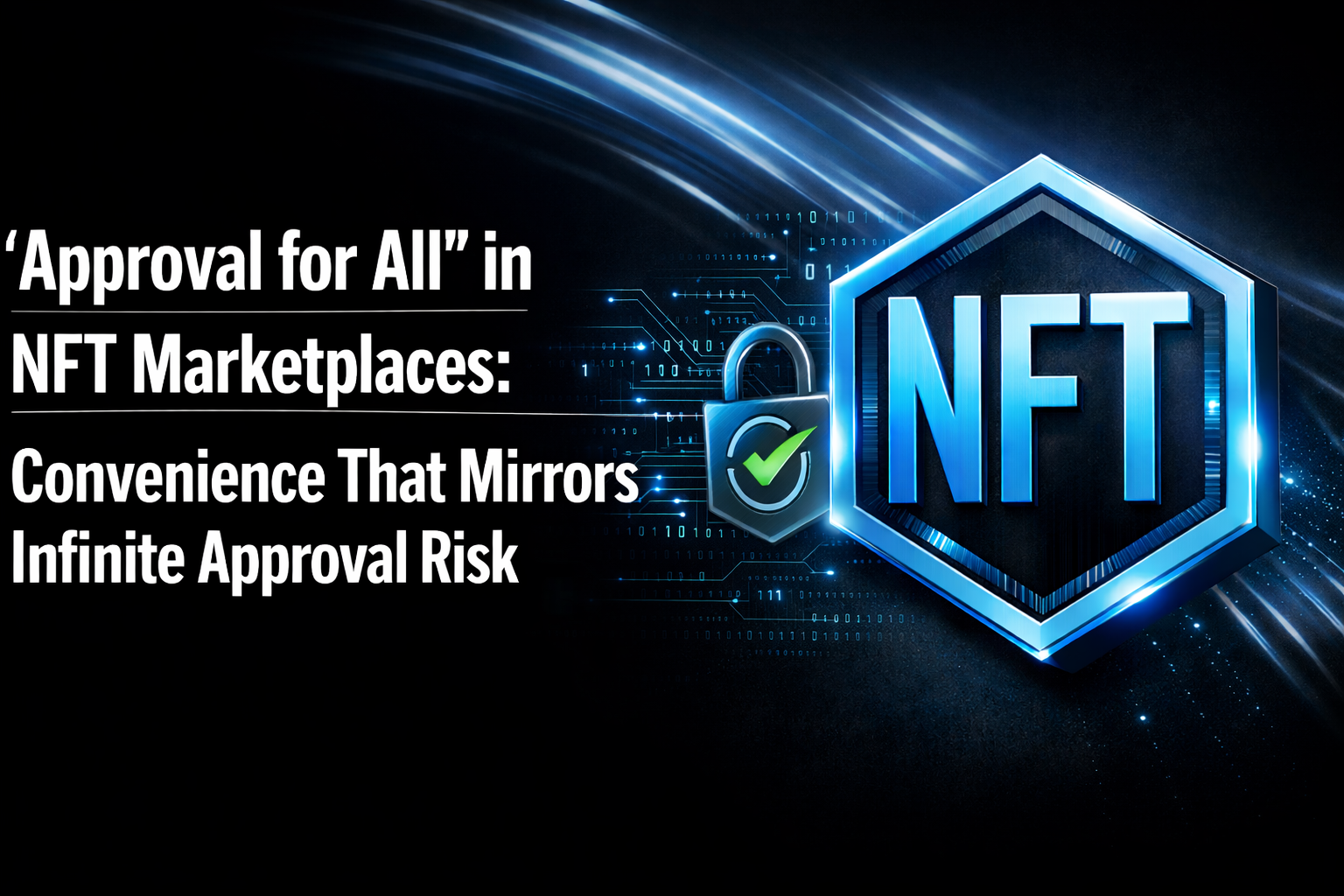
As NFT marketplaces mature and transaction volumes grow, a core permission mechanism known as “Approval for All” is increasingly being recognized as a structural security risk — one that closely mirrors the dangers of infinite token approvals long debated in decentralized finance (DeFi).
While “Approval for All” was introduced to reduce friction and gas costs for NFT trading, security experts warn that it grants persistent, broad control over user assets, creating an attack surface that can be exploited if smart contracts are compromised, misused, or maliciously designed.
What “Approval for All” Really Grants
Under widely used NFT standards such as ERC-721 and ERC-1155, “Approval for All” authorizes a smart contract — typically an NFT marketplace — to transfer any NFT from a specific collection held by a user’s wallet.
Once granted, the permission allows the marketplace to:
- Transfer NFTs without further wallet prompts
- Execute sales automatically when buyers are found
- Manage listings, delistings, and transfers at scale
Critically, this authorization does not expire automatically. It remains active indefinitely unless the user manually revokes it — a design choice that prioritizes usability over granular control.
Why It Is Equivalent to Infinite Approvals
From a security perspective, “Approval for All” functions almost identically to infinite ERC-20 token approvals used in DeFi:
- Both grant broad, persistent access
- Both remain active until manually revoked
- Both assume the underlying smart contract remains secure forever
In DeFi, infinite approvals allow contracts to spend unlimited tokens. In NFTs, “Approval for All” allows contracts to transfer any approved NFT. The asset type differs, but the risk model is the same.
This equivalence is why blockchain security professionals increasingly describe “Approval for All” as infinite approval for NFTs.
The Trade-Off: Speed vs. Control
Why marketplaces use it
- Faster checkout and listing workflows
- Fewer wallet pop-ups
- Lower gas fees for frequent traders
- Higher liquidity and improved user experience
Why it’s risky
- If a marketplace contract is hacked, attackers may drain NFTs instantly
- If a platform becomes malicious or compromised, assets can be transferred without warning
- Users often forget old approvals remain active across wallets and chains
The risk is not hypothetical. Past exploits across DeFi and NFT ecosystems have demonstrated that approval misuse is one of the most common attack vectors in Web3.
User Awareness Remains the Weakest Link
One of the most concerning aspects of “Approval for All” is that users rarely revisit approvals once granted. Wallet interfaces often fail to surface active permissions clearly, and many traders accumulate dozens — sometimes hundreds — of live approvals over time.
This creates a silent exposure layer where assets appear safe but are, in reality, accessible to multiple external contracts.
Security experts emphasize that revocation hygiene is now as important as private key management.
Best Practices for NFT Users
To reduce risk while maintaining usability, experts recommend:
- Regularly reviewing and revoking unused approvals
- Limiting approvals to well-audited, reputable marketplaces
- Using wallet tools or dashboards that visualize active permissions
- Revoking approvals immediately after completing high-value transactions
For power users, rotating wallets and isolating high-value NFTs into “cold” wallets with no approvals is increasingly considered a best practice.
Implications for the NFT Ecosystem
The growing scrutiny around “Approval for All” highlights a broader challenge facing Web3: how to balance frictionless UX with long-term asset security.
As NFT adoption expands beyond crypto-native users, marketplaces may face pressure to:
- Introduce time-bound or scoped approvals
- Improve transparency around permissions
- Educate users more clearly at the point of approval
Until then, “Approval for All” remains a powerful — but risky — mechanism that shifts responsibility from platforms to users.
Key Takeaway
“Approval for All” is not inherently malicious, but it is structurally equivalent to infinite approvals. Convenience comes at the cost of persistent trust in smart contracts — and in Web3, trust without verification remains a vulnerability.
Sources
- Outlook India — Why “Approval for All” in NFT Marketplaces Is Like Infinite Approvals
https://www.outlookindia.com/xhub/blockchain-insights/why-approval-for-all-in-nft-marketplaces-is-like-infinite-approvals - Outlook India — How to Check and Revoke Infinite Approvals in Crypto Wallets
https://www.outlookindia.com/xhub/blockchain-insights/how-to-check-and-revoke-infinite-approvals-in-crypto-wallets - Binance Blog — The Risks of Approving Smart Contract Transactions
https://www.binance.com/en/blog/security/4317275693972329667 - Crypto.ro — Infinite Approval: Definition and Security Implications
https://crypto.ro/en/dictionary/infinite-approval/